Jun 01 2026

If I have a US passport, do I need another ID to enter the US?

We had a disconcerting experience last month when we returned from a trip abroad and entered the US at San Francisco International Airport: When we opted out of facial recognition (which is posted as being optional for US citizens) and presented our US passport, the US Customs and Border Protection (CBP) officer asked us for a second piece of identification. “Since you opted out of facial recognition, I need to see some other ID.”

“Is there some question  as to my identity or citizenship?”

“No, but because you opted out of facial recognition, you have to show me a second piece of ID.”

By law (22 U.S. Code § 2705), a valid US passport is defined not just as “evidence” but as “proof” of US citizenship. What other ID would we have that would constitute evidence of identity and US citizenship? The CBP officer didn’t say.

For years, we’ve been getting reports from US citizens who have been told that submitting to facial recognition is required to enter or to leave the US, even while CBP officials have persisted in claiming that “no US citizen is ever required to  be photographed in order to enter or leave the US.”

But we haven’t previously heard of anyone being told that, while they could opt out of facial recognition, that would lead to their US passport not being accepted as ID.

Eventually, after we repeated three or four times that the evidence of our citizenship and identity was our US passport, the CBP officer allowed us to enter the country — but only after quizzing us about our travel history, to see if our answers matched with the border crossings logged in CBP’s Automated Targeting System.

How many international trips did we make last year? What country or countries did we visit on our last trip? Were we certain about that? No, we aren’t certain where CBP thinks we’ve been, or whether CBP has an accurate or complete record of our movements, especially with respect to countries we didn’t enter or leave directly from or to the US.

We followed up with CBP to try to find out if we had encountered a rogue or ill-trained CBP officer, a new unwritten (and illegal) but systemic CBP practice, or a new official (and illegal) CBP policy.

Several weeks later, we got the following message from CBP spokesperson  Erica Austin:

U.S. Customs and Border Protection policies remain unchanged: biometric facial comparison technology is optional for U.S. citizens… CBP confirms the use of biometric facial comparison technology at ports of  entry is voluntary for U.S. citizens. A valid U.S. passport is sufficient to verify citizenship and identity. Officers may request additional documents if further verification is needed, but opting out of biometric facial comparison technology does not automatically require a second form of ID. However, officers may request additional documents during inspection if there are concerns about identity, discrepancies in information, or issues with the passport itself.

This contradicts what happened to us: The CBP officer told us explicitly that there was no question as to our identity and citizenship, and that the only reason for their demand for a second piece of ID was our opting out of facial recognition.

Unsurprisingly, CBP didn’t mention of any reprimand or retraining for the officer.

Refusal to recognize a US passport, or giving automated facial recognition more weight than a US passport as evidence of identity and citizenship, is a serious breach of the law and of the rights of citizens. We’re pleased to know that official policy hasn’t changed, but concerned as to how widespread the illegal practice we encountered may be.

If you’re a US citizen and you’ver been asked for additional ID or subjected to additional questioning by CBP when you opted out of facial recognition, please let us know.

May 22 2026

Minnesota OK’s “open” meetings behind TSA checkpoint

The Minnesota Commissioner of Administration  has issued a formal advisory opinion that it doesn’t violate the state’s open meeting law for the Minneapolis-St. Paul Metropolitan Airports Commission (MAC) to hold its meetings in location behind a TSA checkpoint and accessible only by showing REAL-ID or paying a $45 fee, as long as the MAC offers to pay (or reimburse) the fee for those seeking to attend MAC meetings.

The advisory opinion addressed only the following question:

Does the Metropolitan Airports Commission Board of Commissioners policy requiring attendees to pay for TSA ConfirmID or obtain a Real ID or passport to attend meetings violate Minnesota Statutes, section 13D.01 to hold open meetings?

The advisory opinion only addresses the requirement to pay the fee or show REAL-ID. This leaves unresolved an issue on which we requested an opinion, but which the Commissioner declined to address: Whether Minnesota’s open meeting law permits the MAC or another state body to hold meetings in a location to which access is under the control and subject to the standardless discretion of the TSA or another third party. The TSA claims the right to deny passage to anyone, regardless of whether they show REAL-ID, pay the illegal $45 fee, or respond to the TSA’s unlawful questioning.

Apr 06 2026

Is a meeting “public” if you have to show REAL-ID or pay a fee?

At our request, the Minnesota Commissioner of Administration has directed the state’s Data Practices Office (DPO) to issue an advisory opinion as to whether the Minneapolis-St. Paul Metropolitan Airports Commission (MAC) violates the state’s Open Meeting Law by holding its meetings in an area at the MSP airport accessible only by passing through a TSA checkpoint, which requires either REAL-ID compliant ID, a passport, or paying a $45 fee.

The Commissioner has complete discretion to decide when to issue an advisory opinion. We are pleased that they have decided to do so in this case. We thank the DPO for their (unsuccessful buy helpful) efforts at informal mediation with the MAC, which preceded our request for a formal advisory opinion.

So far as we know, this will be the first official review by any state or local government body, under any state or local open meeting law, of whether a meeting of a government body can be considered “public” or “open” if REAL-ID or a fee is required for entry.

As stated in the Commissioner’s notice of the preparation of an advisory opinion, under Minnesota law, “Although the advisory opinion will not be binding on the Board, a court must give the opinion deference.”

We look forward to the Commissioner’s opinion. According to the notice , “Section 13.072 requires the Commissioner to issue an opinion within 50 days of receipt of the request. Therefore, the Commissioner must issue the opinion by May 21, 2026.”

Feb 17 2026

Show ID or pay a fee to attend a “public” meeting?

Is it an “open” meeting if you have to identify yourself, show ID, and/or pay a fee to attend?

That’s the question presented by today’s meeting of the Minneapolis-St. Paul Metropolitan Airports Commission (MAC), which is scheduled to be held in the “secure” area of the MSP airport reachable only by passing through the Transportation Security Administration (TSA) checkpoint.

As of February 1, 2026, this means individuals who want to attend a MAC meeting, including those who want to make public comments and those who just want to observe, must either (A) show ID credentials the TSA finds satisfactory or (B) pay the illegal $45 per person TSA Confirm.ID fee, answer whatever questions the TSA asks (based on records of the Accurint data broker), and be “allowed” by the TSA, in its unreviewable and arbitrary discretion, to enter the secure area of the airport. The MAC website says that “the MAC will cover this cost for up to three meetings”, but doesn’t say what will happen after that.

This is the first time — in Minnesota or any other state — that we have seen a demand for ID, a demand for a fee, a limit on the number of meetings that can be attended without a fee, or delegation of authority (authority the MAC itself would lack) to an independent third party to demand answers to questions or to decide in its discretion  who to allow to attend a meeting of a government body required by law to be open to the public.

Is any of this legal? We doubt it.

Rules for meetings of government decision-making bodies vary by state. The MAC is a Minnesota state agency whose members are appointed by the Governor.  The Minnesota Open Meeting Law (Minnesota Statutes Chapter 13D) requires that all decision-making meetings of entities such as the MAC “must be open to the public”.

The Minnesota law doesn’t define what “open to the public” means, but we don’t think it includes any of these conditions and restrictions on attendance:

  1. Requiring individuals to identify themselves (rather than attending anonymously, as they may wish to do if e.g.  they fear retaliation for attending or making public comments).
  2. Requiring individuals to have or show ID credentials.
  3. Requiring individuals to answer questions including questions from a third party (in this case, the TSA).
  4. Require individuals to pay a fee, or limiting the number of open meetings an individual may attend without paying a fee. (In this case, the fee is patently illegal, and having agreed to pay the fee on behalf of individuals attending MAC meetings, the MAC itself would have standing to challenge the fee.)
  5. Granting a third party discretion to decide who will, and who will not, be allowed to attend a meeting. (The MAC website notes that “Verification is not guaranteed”, i.e that the TSA may choose not to allow an individual to pass through the checkpoint, even if they identify themselves verbally, pay the $45 fee or have it paid for them, and answer all of the TSA’s questions.)

None of this fits within any reasonable definition of “open to the public”.

Any member of an entity subject to the Minnesota Open Meetings Law who violates this law, including by attending a business meeting of an agency that isn’t open to the public, is personally liable for a $300 fine for each “occurrence”. They have to pay the fine themselves. The agency isn’t allowed to pay it for them. Under a “three strikes you’re out” provision of this law, any office-holder found guilty of three separate violations of the Open Meetings Law forfeits their office for the remainder of their term.

Meanwhile, we’re still waiting for a full response to our request under the Minnesota Government Data Practices Act for information about the basis for the MAC’s dubious claim that it lacks any authority to limit where in the airport Federal agents can go.

The last word we received is that we can expect a response to our public records request tomorrow — the day after the monthly MAC meeting today at which we and others might (if we were allowed by the TSA to attend) have asked questions of MAC members about the decision to give Federal agents free run of the airport without challenge.

Feb 11 2026

First-hand reports confirm you can still fly with no ID

First-hand reports confirm that some people can still fly with no ID card or documents, despite a new scheme of the Transportation Security Administration (TSA) to extort an illegal $45 fee from each airline passenger who doesn’t have, or doesn’t choose to show, ID that the TSA deems to be “compliant” with the REAL-ID Act.

As long as they pay the $45 fee, travelers with no ID or with noncompliant ID have been treated the same way as before the the TSA began demanding the fee on February 1, 2026:

We’ve seen no report of the TSA stopping travelers without ID or without REAL-ID from flying, as long as a they have paid the illegal $45 per person fee.

The only apparent change since the imposition of the $45 fee on February 1 of this year is that instead of phoning the TSA’s ID Verification Call Center (IVCC) and relaying questions and answers verbally between the IVCC and travelers without ID, TSA checkpoint staff are now using a laptop or tablet app to receive the questions and send back the  answers.

The TSA has complied with none of the legal requirements for notice and approval of the information-collection app being used for questioning of travelers without ID. This leaves it unclear whether a human is still involved in fly/no-fly decisions about travelers without ID or whether this decision-making has been delegated to secret algorithms encoded within the app or at the central site that connects the app to Accurint.

We haven’t yet seen any reports of what happens if a traveler without ID or without REAL-ID who hasn’t paid the $45 fee or tries to go through a TSA checkpoint, or doesn’t leave when told to do so. Nor have we heard what happens if a traveler without ID exercises their right to remain silent when questioned about their Accurint file by checkpoint staff. We expect that they would be arrested by local police and/or assessed a civil penalty by the TSA. The Paperwork Reduction Act provides a “complete defense” against any such penalties, but raising that defense would be risky and could be expensive.

Jan 29 2026

TSA plans illegal ID and fee shakedown starting Feb. 1, 2026

For more than twenty years, we’ve seen a never-ending succession of lawless empty threats made by the Transportation Security Administration (TSA) and Department of Homeland Security (DHS) — amplified by airlines, airport operators,  and state driver licensing agencies — to prevent ticketed airline passengers from exercising their right to travel by common carrier if they don’t have or show ID or show state-issued IDs not certified by the DHS as “compliant” with the Federal REAL-ID Act of 2005.

To date, none of these threats have been carried out.

Now the TSA is threatening, yet again unlawfully, that starting February 1, 2025 it will prevent any traveler from passing through a TSA or TSA-contractor checkpoint at a US airport with no ID or “non-compliant” ID unless they (1) pay an illegal $45 per person fee and (2) submit to as-yet undisclosed new “identity verification” procedures that are likely to include illegal demands for additional personal information.

What will happen on February 1st  if you try to fly without ID, or without REAL-ID, and without paying the $45 fee or answering more questions? Will the TSA stop you from flying? If so, how can you challenge the TSA’s denial of your right to travel?

Read More

Jan 23 2026

Exceptions and limitations to your rights

When we posted our latest know-your-rights guide, we noted that it describes the rights of U.S. citizens if you are stopped and/or asked to identify yourself or show ID documents in certain circumstances: as a pedestrian, as a passenger in a car (not the driver), at home, or at the airport for a domestic flight.

Why these exceptions and limitations? What about drivers of motor vehicles, passengers on international flights, and people who aren’t U.S. citizens? Don’t they have rights too?

Yes, everyone has rights. But we limited our guide to circumstances in which we think the law is clearly established. In other situations, U.S. courts have been less clear, and in some cases these issues are the subject of ongoing litigation.

Here are some notes on these exceptions and limitations:

  • Non-U.S. citizens: All people have rights, regardless of their citizenship. The Bill of Rights refers to the rights of “persons”, not citizens. The U.S. is a party to international treaties, including the International Covenant on Civil and Political Rights (ICCPR), which according to the U.S. Constitution are the “supreme law of the land” just as much as the Constitution itself. Human rights, by definition, don’t depend on citizenship. But U.S. courts have often (wrongly, we think) interpreted some of the references to “persons” in the Bill of Rights and other U.S. laws as applying only to U.S. citizens and sometimes to permanent U.S. residents, not to all people. And U.S. courts have made it difficult or impossible to enforce rights recognized by the ICCPR, other international treaties, or customary international law through U.S. courts. In practice, non-U.S. citizens have fewer rights likely to be recognized by U.S. courts. U.S. law requires each non-U.S. citizen 18 or older in the U.S. for more than 30 days to register with the U.S. government and “at all times carry with him and have in his personal possession” their registration certificate. That law is of dubious validity, and hasn’t generally been enforced. It says non-U.S. citizens must “carry” their papers, but is silent on whether or when they are required to show those papers. Recent renewed enforcement of this law has prompted ongoing litigation in which these issues have been raised but not yet resolved. See  this know-your-rights brochure and these other resources from the American Immigration Lawyers Association for more on the rights of non-U.S. citizens.
  • Drivers of motor vehicles: Unlike a mere passenger, the operator of a motor vehicle on a public road must have a license and must show their license to police if they are lawfully stopped. Case law on what constitutes a lawful traffic stop is complex and voluminous, with variations from state to state.  A key unresolved question is whether or in what circumstances ICE agents or other Federal law enforcement officers have the authority to make traffic stops or demand drivers licenses to investigate possible violations of state motor vehicle or traffic laws. In one recent ruling in an ongoing lawsuit in Minnesota, for example, the District Court Judge wrote that, “the Court declines to wade into whether federal immigration enforcement officers have any authority to enforce Minnesota’s traffic laws.”
  • Passengers on international flights to and from the U.S.: Here again the case law is voluminous, complex, and silent on some key issues.  Federal agents have been allowed broad authority to stop and search anyone entering or leaving (or seeking to enter or leave) the U.S., whether at a land border or at an international airport or seaport.  Non-U.S. citizens can, in many cases, be denied entry to the U.S. if they decline to answer questions. But we can find no case law on the limits of the right of a U.S. citizen to remain silent in response to questions at the U.S. border or an international port of entry or exit, once they have declared their U.S. citizenship. (See more here about your rights at the airport for a domestic flight.)

We also noted in our guide that in some states, but not others, you might have to identify yourself verbally, if you have been legally stopped based on reasonable suspicion, but you don’t have to say anything else or show any papers. We think state “stop and ID” laws are unconstitutional. But whether “stop and ID” laws conflict with the 5th Amendment right to remain silent has not, so far as we can tell, been resolved by the courts.

Having the legal “right” to do something doesn’t mean that, in practice, you can do it without the police stopping you or retaliating against you for trying to exercise your rights. Retaliatory policing and retaliatory prosecutions are illegal but common.

Whether you are arrested, prosecuted, tortured, or shot by police, jailers, or prison guards may depend on the color of your skin,  your accent, what neighborhood you are in, whether you are wearing a hijab or other indicia of faith or ethnicity, or other aspects of your appearance and the situation, rather than on whether you are breaking the law.

Different people face different risks in trying to exercise their rights. Many of these risks are not ones individuals can choose whether to take. You are unavoidably “at risk”, to a greater or lesser degree, whether or not you chose to take additional risks. The law won’t always protect you. But neither will complying with the law always protect you.

One thing is certain: Your legal rights don’t matter if you never try to use them.

Jan 16 2026

Know Your Rights as a U.S. Citizen

ICE agents in Minneapolis violently detain and arrest U.S. citizen for one reason: he refused to prove his citizenshipe

Immigration and Customs Enforcement (ICE) agents and an assortment of other masked Federal officers are arresting U.S. citizens for not showing ID or “proof” of citizenship on the streets, at traffic stops, and in warrantless door-to-door searches in the Twin Cities.

ICE is planning to station agents to “check documents” on the jetbridges at the Minneapolis-St.Paul International Airport.

With all this happening, we’ve posted a new know-your rights FAQ for U.S. citizens, “Do I have to show ID as a pedestrian, passenger in a car (not the driver, for whom the rules are different), at my home, or at the airport for a domestic flight?” (Also available here as a printable one-page PDF.)

This know-your-rights guide is for U.S. citizens. The law is different for those who aren’t U.S. citizens: U.S. law requires non-U.S. citizens in the U.S. for more than 30 days to register with the U.S. government and carry  their papers “at all times”.  But there are many other good resources for non-U.S. citizens such as this brochure. We’ve found few other clear guides to the rights of U.S. citizens in situations like those today in Minnesota, in which U.S. citizens are being (illegally) required to prove their right to walk the streets, live peacefully in their homes, or travel within their own country.

This guide is a work in progress. We’ve posted it quickly because the need seems urgent. We welcome suggestions for corrections or changes.

Knowing and asserting your rights protects everyone in our society — including non-U.S. citizens. It shows other people that they have rights too, and shows police that we know we have rights. Rights are not, in and of themselves, a protection. You can’t count on police to respect your rights. But police act differently when people know and assert their rights.

Liberty lives in its exercise. Freedom dies if it’s not used. Know your rights — and use them.

Jan 15 2026

TSA extorts $45 from each air traveler without REAL-ID

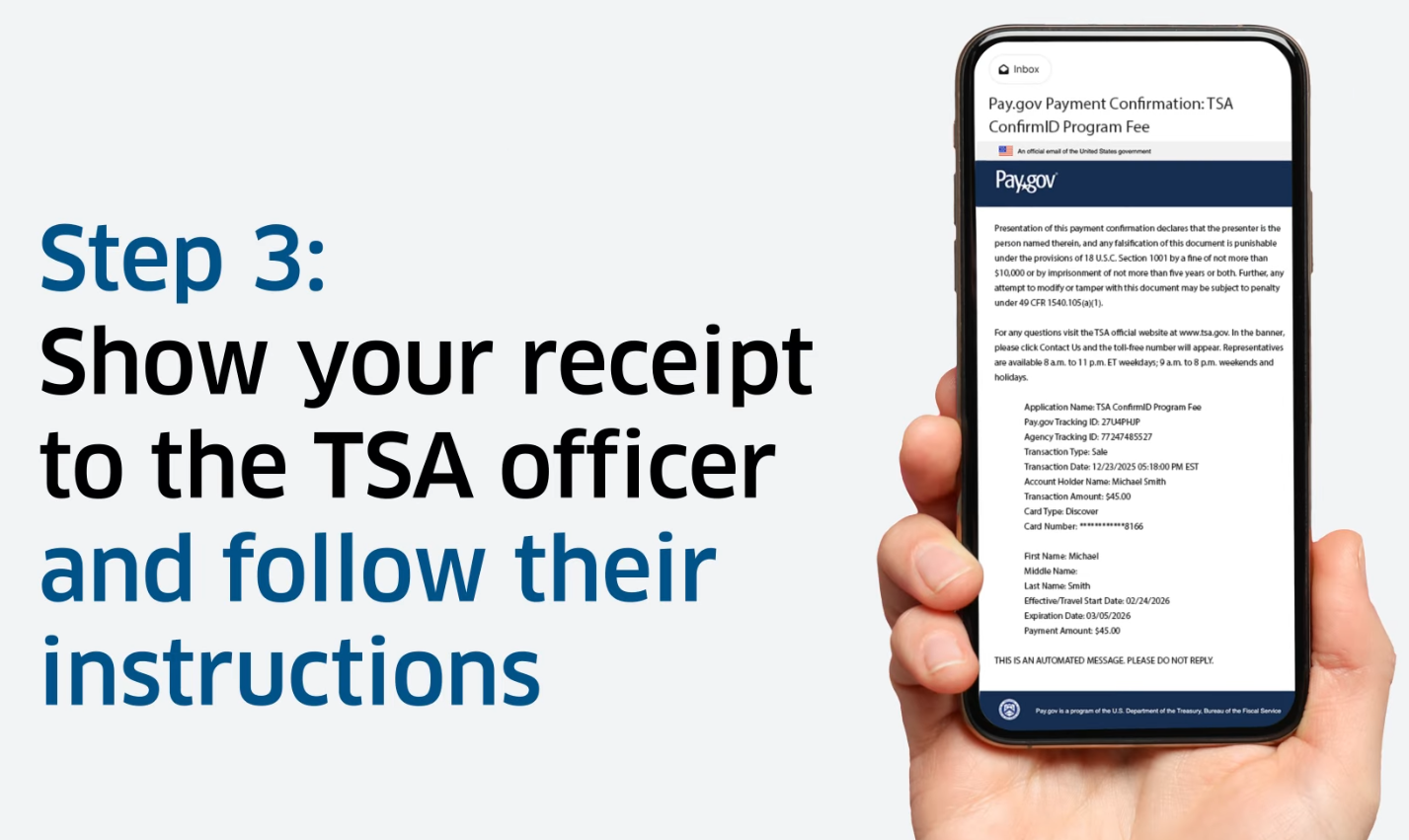
screenshot: Step 3: Show your receipt to the TSA officer and follow their instructions

Today the TSA launched a flagrantly illegal new extortion program, TSA ConfirmID,  to collect $45 from each airline passenger who wants to fly without showing REAL-ID.

As of today, only the payment platform for this “ID verification” program is operational. If you want to fly without REAL-ID on or after February 1, 2026, a new TSA video instructs you to pay $45 each through the Pay.gov website, bring your receipt to the TSA checkpoint at the airport, “show your receipt to the TSA officer and follow their instructions”.

Payments are accepted by ACH transfer from a bank account, credit or debit card, Venmo, or PayPal.

What will the TSA officer instruct you to do at the checkpoint? The TSA says that:

TSA will then attempt to verify your identity so you can go through security; however, there is no guarantee TSA can do so. Please note: Using TSA ConfirmID is optional. If you choose not to use it and don’t have an acceptable ID, you may not be allowed through security and may miss your flight.

The TSA says that you “may” not be allowed through the checkpoint, not that you “will” not. And the TSA’s FAQ says that, “In the event you arrive at the airport without acceptable identification (whether lost, stolen, or otherwise), you may still be allowed to fly”.

What are the procedures for this “attempt to verify your identity”? What are the criteria for  whether or not the TSA will allow you to fly? We don’t know.

A TSA propaganda video released last week falsely claims that, “Everyone knows that when you fly you have to bring a REAL-ID or a passport.” In fact, 200,000 people a day fly without REAL-ID and without a passport. (Any passport of any country is considered REAL-ID.)

It’s unclear what will happen to travelers who show up at TSA checkpoints on February 1st without REAL-ID, or with no ID at all, whether or not they have paid the $45 per person “TSA ConfirmID” fee. See our FAQ about your rights and what might happen.

As we pointed out when the TSA announced this plan in December, no law authorizes this scheme. No law requires airline passengers to have, carry, or show any ID — as the TSA itself has consistently argued, at least to date, when the issue has been raised in court.

The TSA has promulgated no regulations for “TSA ConfirmID”, has published no Privacy Act notice for the information collected from travelers either when they pay the $45 fee or when they go through the TSA checkpoint, and has neither requested nor received approval from the Office of Management and Budget (OMB) for this collection of information, as is required by the Paperwork Reduction Act (PRA).

“TSA ConfirmID” isn’t mentioned in any of the Privacy Act notices for the TSA’s systems of records. Operation of a system of records by a Federal agency without first publishing a proper notice in the Federal Register is a criminal violation of the Privacy Act on the part of the responsible  agency employees:

Any officer or employee of any agency who willfully maintains a system of records without meeting the notice requirements of subsection (e)(4) of this section shall be guilty of a misdemeanor and fined not more than $5,000.

Presumably, data collected from individuals who pay the $45 “TSA ConfirmID” fee is passed on to the TSA and stored in some (undisclosed) TSA system of records. The TSA officers and employees responsible for that system of records are, as of today, criminals.

Even the payment platform for the $45 fee is in flagrant violation of multiple Federal laws. The Pay.gov payment site and TSA ConfirmID payment form display no OMB control number, as is required by the PRA.

The Department of the Treasury, which operates Pay.gov, says specifically that:

An agency may not conduct or sponsor, and a person is not required to respond to, a collection of information unless it provides notice of a currently valid Office of Management and Budget (OMB) control number. Among other things, a notice of the expected time burden is required…. Pay.gov provides services to Federal agencies. These services include the posting of agency forms. Required notices that accompany these forms are the responsibility of those agencies.

There’s a link from the payment page to a Privacy and Security Policy, but the linked page doesn’t mention the Privacy Act, the PRA, or an OMB control number.

Since the TSA hasn’t chosen to follow the law or disclose any of its plans, the only way to figure out the de facto “rules” is to reverse engineer them from travelers’ experiences.

If you show up at a TSA checkpoint on or after February 1st without REAL-ID, or with no ID, please let us know whether or not you paid the “TSA ConfirmID fee” and what happened to you at the cehckpoint..

Keep a copy and/or take a photo or screenshot or any printed or online forms you are asked to fill out. If the forms or user interface pages don’t include a valid OMB control number, you can legally ignore them without penalty.

Are you allowed to fly without REAL-ID? With no ID? Without paying the “TSA ConfirmID” fee? If you are prevented from flying, who stops you? What do they say is the basis for their action?

You have the right to film and record at TSA checkpoints. Please share your experiences so we can better inform future flyers without ID or without REAL-ID.

Dec 01 2025

USCIS is trying to make a list of all U.S. citizens

U.S. Citizenship and Immigration Services (USCIS), a Federal agency whose mandate is to administer naturalization and derivative citizenship for those not born as U.S. citizens, has been trying — without the public notice required by law for such a database — to construct a national ID registry of all U.S. citizens including natural-born U.S. citizens.

This process began in April and May of 2025 with a ten-fold expansion of the USCIS “Systematic Alien Verification for Entitlements Program” (SAVE) database to add records about hundreds of millions of native-born U.S. citizens to those already in the system about tens of millions of naturalized citizens and immigrants.

Information about a new category of individuals (native-born U.S. citizens) was added to SAVE from new sources including Social Security and state drivers’ license records.

The Privacy Act requires prior notice in the Federal Register of the categories of individuals, information, and sources of personal data in Federal databases. To deter Federal officials or employees form keeping secret databases about the citizenry, the Privacy Act makes the maintenance of such a database of personal information without proper notice a crime on the part of the responsible Federal officials and employees.

USCIS converted the SAVE database about immigration and naturalization into a comprehensive  database about all U.S. citizens without the required notice.

Six months later, in response to a lawsuit led by the League of Women Voters, USCIS published a notice of the changes to the SAVE system, with the notice to take effect today unless the changes are rescinded in response to public comments. But USCIS has kept the the revised SAVE system in operation, illegally, during the comment period.

In our comments submitted today to USCIS, the Identity Project points out that the ongoing maintenance of the revised SAVE system without proper notice has been a crime on the part of the responsible Federal officials and employees.

We also argue that “the revisions to the SAVE system of records exceed the statutory authority of USCIS and violate multiple provisions of the Privacy Act.”

According to our comments:

The statutory mandate of USCIS is to carry out various functions with respect to naturalization and derivative citizenship. No statute requires USCIS to carry out any function whatsoever with respect to natural-born U.S. citizens, or to collect information about them. Nor does any statute require any agency to maintain a national registry of U.S. citizens.

Even if Congress were to authorize  a national ID registry, “records of Social Security numbers and account information and state drivers’ license records would not be ‘relevant or necessary’ to accomplish that purpose”:

Pursuant to the U.S. Constitution, an individual born in the U.S. acquires U.S. citizenship by birth. In the absence of a valid renunciation of citizenship — which would be executed and recorded by the Department of State, not by USCIS, the Social Security Administration (SSA), or state drivers’ license agencies — the sole fact that is relevant or necessary to ascertain their U.S. citizenship is the fact of their birth in the U.S., not whether they have a Social Security number or drivers’ license, much less any other information in SSA or drivers’ license records.

What is the relevance of whether someone has a Social Security number to whether they are a U.S. citizen? Non-U.S. citizens can and routinely do (and in many cases must) have Social Security numbers and accounts. What is the “relevance” of whether an individual has a driver’s license to whether they are a U.S. citizen? Many states can and do issue driving permits to non-U.S. citizens, on the basis of their demonstrated competence to operate motor vehicles safely rather than on the basis of citizenship. Neither the Social Security Administration nor state driver licensing agencies are authoritative adjudicators of U.S. citizenship, and neither of them has any need, for any of their official purposes, to ensure that whatever information about U.S. citizenship they may incidentally collect and maintain is either accurate or up to date.

Will anyone who doesn’t have a drivers’ license be presumed not to be a U.S. citizen?

A “citizenship” registry constructed in garbage-in, garbage-out fashion by aggregating state drivers’ license records that have nothing to do with citizenship will inevitably be incomplete, inaccurate, and unfit for the purpose of judging citizenship, eligibility to vote, or eligibility for other Federal programs.

Finally, we call out USCIS for violating the provision of the Privacy Act that requires information that is to be used to determine eligibility for Federal programs (the stated purpose of the SAVE citizenship database) to be collected directly from the individuals to whom it pertains:

The Privacy Act at 5 U.S.C. § 552a(e)(2) also requires that, “Each agency that maintains a system of records shall… (2) collect information to the greatest extent practicable directly from the subject individual when the information may result in adverse determinations about an individual’s rights, benefits, and privileges under Federal programs.”

None of the additional information in the revised SAVE system would be collected directly from the subject individuals, as required by this provision, although all of it could be.

If USCIS wants to create a registry of all U.S. citizens (and if a valid law has authorized it to do so, which it has not), USCIS must “to the greatest extent practicable” sign individuals up directly for that registry, first providing them with the notices required by the Privacy Act.

You can submit your own comments here through midnight EST tonight, December 1, 2025.

Given that the criminals at USCIS responsible for maintaining the SAVE system ignored the law when they expanded it into a  national ID registry, kept it in operation for six months before publishing a proper notice of what they were already doing, and have kept it in operation in its illegally revised and expanded form during the comment period, we have little hope that they will now come to their senses and rescind the changes, much less that they will be prosecuted for their criminal violations of the Privacy Act.

We wish all success to the League of Women Voters and their partners in their ongoing litigation against the unlawful transformation of this immigration and naturalization system into a national database of aggregated (mis)information about all U.S. citizens.